
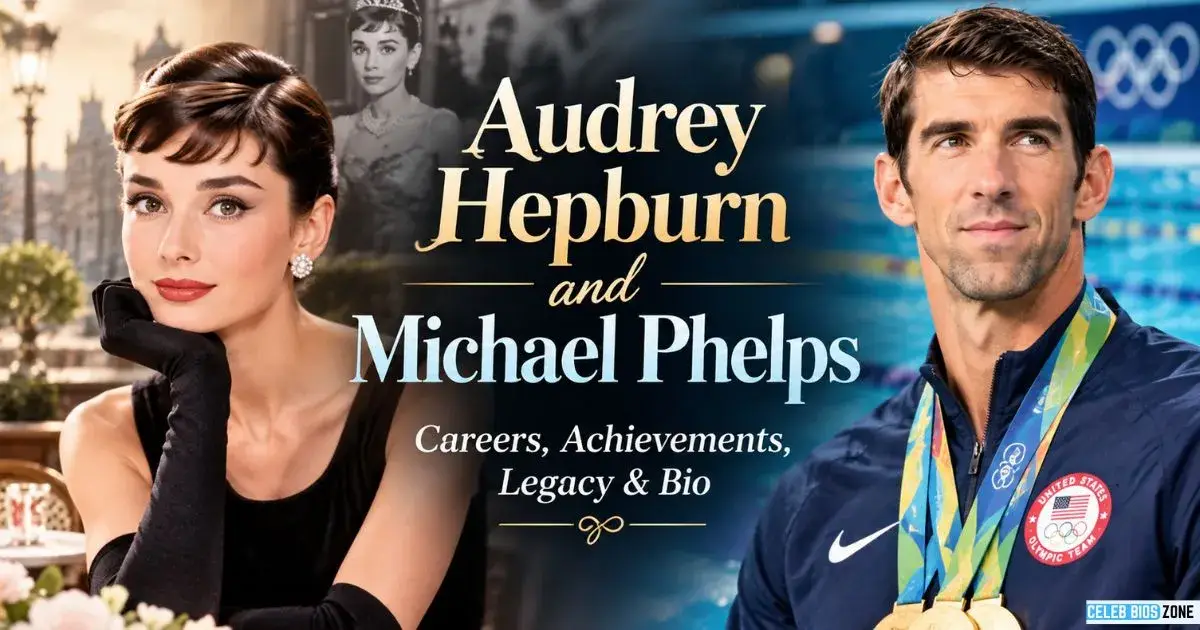
Two extraordinary careers, one fascinating comparison: Audrey Hepburn and Michael Phelps reached global fame through entirely different paths. Hepburn became a celebrated British actress whose performances in Roman Holiday and Breakfast at Tiffany’s shaped classic cinema. Phelps, meanwhile, dominated the pool as an American swimmer, collecting an unmatched haul of Olympic medals across five Games.
Their stories extend beyond awards and records. Hepburn became a dedicated humanitarian and UNICEF Goodwill Ambassador, while Phelps turned his platform toward mental health advocacy, water safety, and youth development. This article examines their early lives, professional milestones, family stories, wealth, public influence, and lasting legacy while separating documented facts from popular claims surrounding these two global icons.
Audrey Hepburn and Michael Phelps at a Glance
Audrey Hepburn and Michael Phelps built fame in completely different arenas. Hepburn became a British actress and cultural icon through classic cinema, while Phelps became an American swimmer and Olympic champion. Their estimated wealth also comes from different sources: Hepburn’s estate and film legacy versus Phelps’s endorsements, investments, and business ventures. Published estimates vary because neither figure represents an audited public balance sheet.
| Quick Detail | Audrey Hepburn | Michael Phelps |
|---|---|---|
| Full Name | Audrey Kathleen Hepburn-Ruston | Michael Fred Phelps II |
| Born | May 4, 1929 | June 30, 1985 |
| Birthplace | Brussels, Belgium | Baltimore, Maryland |
| Profession | Actress, humanitarian | Olympic swimmer, entrepreneur |
| Best Known For | Roman Holiday, Breakfast at Tiffany’s | 28 Olympic medals |
| Olympic Gold Medals | Not applicable | 23 |
| UNICEF Role | Goodwill Ambassador, 1988–1993 | Not applicable |
| Estimated Net Worth | About $10–20 million at death; current estate estimates vary | About $100 million in widely cited 2026 estimates |
| Major Wealth Sources | Acting, royalties, estate rights | Endorsements, investments, business ventures |
| Legacy | Film, fashion, humanitarian work | Olympic sport, athlete advocacy |
Audrey Hepburn Quick Facts
Audrey Hepburn’s biography spans film, fashion, and humanitarian work. She experienced a difficult wartime childhood in the Netherlands before pursuing ballet training and an early performing career. Her breakthrough came with Roman Holiday, which earned her the Academy Award for Best Actress. Later, her UNICEF work became a defining part of her public legacy.
Michael Phelps Quick Facts
Michael Phelps biography centers on extraordinary swimming achievements and sustained discipline. The competitive swimmer represented the United States at five Olympic Games and collected 28 Olympic medals, including 23 gold medals. His post-swimming career expanded into endorsements, business ventures, mental health advocacy, and water safety initiatives.
Who Were Audrey Hepburn and Michael Phelps?
Audrey Hepburn and Michael Phelps became global icons through entirely different careers. Hepburn was a British actress celebrated for classic cinema, fashion, and humanitarian work. Phelps is an American swimmer whose Olympic career produced an unmatched collection of medals and records.
Their stories also share an interesting thread. Both turned professional excellence into lasting public influence. Hepburn used her public platform for children’s causes through UNICEF, while Phelps later focused on mental health advocacy and other athlete-centered initiatives. Their careers show how fame can extend far beyond the field or screen.
Audrey Hepburn’s Early Life and Background
Audrey Hepburn was born on May 4, 1929, in Brussels, Belgium. Her early life unfolded across Europe and was deeply affected by World War II. She studied ballet and developed an early interest in performing before moving toward acting. Those experiences shaped the discipline and resilience that later supported her film career.
After the war, Hepburn pursued ballet training and began taking small performing roles. Her path changed dramatically when writer Colette noticed her and selected her for the Broadway production of Gigi. Soon afterward, Hepburn landed the lead role in Roman Holiday, placing her firmly on the international cinema map.
How Audrey Hepburn Became a Hollywood Icon
Hepburn’s rise to stardom accelerated with Roman Holiday, where she starred opposite Gregory Peck. The performance earned her the Academy Award for Best Actress and established her as a major Hollywood actress. Her distinctive screen persona combined elegance, warmth, humor, and an understated presence that audiences quickly remembered.
From there, her film career expanded through celebrated productions such as Sabrina, Funny Face, Breakfast at Tiffany’s, and My Fair Lady. Yet her influence wasn’t limited to movies. Audrey Hepburn style became closely associated with classic fashion, helping transform her into a cultural icon whose film legacy remains recognizable decades later.
Audrey Hepburn’s Family and Personal Life
Away from her Hollywood career, Audrey Hepburn placed considerable importance on family and privacy. She married actor Mel Ferrer in 1954 and later Italian psychiatrist Andrea Dotti in 1969. She eventually built a quieter life in Switzerland, where motherhood and personal relationships became central to her daily life.
Marriages and Relationships
Hepburn’s personal life included two marriages and a long-term relationship. Her first marriage to Mel Ferrer lasted from 1954 to 1968, while her second marriage to Andrea Dotti lasted from 1969 to 1982. From 1980 until her death, she was partnered with Dutch actor Robert Wolders.
Children and Family
Audrey Hepburn had two sons, Sean Hepburn Ferrer and Luca Dotti. Sean was born in 1960 during her marriage to Ferrer, while Luca was born in 1970 during her marriage to Dotti. Her decision to spend more time raising her children strongly influenced her reduced film career during the late 1960s and afterward.
Her Life Away From Hollywood
By the late 1960s, Hepburn had stepped back from regular acting to focus more heavily on family life. She lived at La Paisible in Tolochenaz, Switzerland, where she enjoyed a quieter routine away from Hollywood. Later, humanitarian work became another major part of her life as she devoted herself to UNICEF and children’s welfare.
Audrey Hepburn’s Fashion and Cultural Influence
Audrey Hepburn became a fashion icon whose influence reached far beyond her film career. Her refined wardrobe, simple silhouettes, and collaboration with designer Hubert de Givenchy helped define Audrey Hepburn style. Films such as Breakfast at Tiffany’s also cemented her place in classic cinema and popular culture.
Her cultural influence remains visible in fashion, photography, film, and advertising. Unlike trends that quickly fade, her understated aesthetic developed a lasting legacy. That combination of elegance and simplicity continues to shape how audiences view one of Hollywood’s most recognizable stars.
Audrey Hepburn’s Humanitarian Work With UNICEF
Hepburn’s humanitarian work became one of the most meaningful chapters of her life. She served as a UNICEF Goodwill Ambassador from 1988 until her death in 1993, using her public platform to draw attention to children facing poverty, hunger, disease, and displacement.
Her humanitarian advocacy also carried personal meaning. As a child during World War II, Hepburn received food and medical assistance connected with UNICEF’s relief efforts. That experience helped shape her later commitment to children’s welfare and children’s rights.
Becoming a UNICEF Goodwill Ambassador
Hepburn became a UNICEF Goodwill Ambassador in 1988. Soon afterward, she traveled to Ethiopia during a severe humanitarian crisis and spoke publicly about what she witnessed. She also gave numerous interviews to raise awareness and support for UNICEF’s work.
Her role went beyond ceremonial appearances. Hepburn addressed audiences, supported fundraising efforts, spoke with policymakers, and participated in major UNICEF events. In 1992, she received the Presidential Medal of Freedom for her humanitarian contributions.
Humanitarian Missions Around the World
Hepburn undertook UNICEF missions across several countries. Her travels included Ethiopia, Turkey, Venezuela, Ecuador, Guatemala, Honduras, El Salvador, Bangladesh, Thailand, Vietnam, and Sudan. These humanitarian missions exposed her directly to health, education, nutrition, water, and child-protection challenges.
In Bangladesh, for example, she visited schools, villages, and community projects during a seven-day trip in 1989. UNICEF records also document her visiting a health clinic and vaccinating a child against polio.
Her Advocacy for Children
Hepburn consistently used her fame to amplify children’s causes rather than simply lend her name to them. She advocated for better health, education, protection, and opportunity for vulnerable children. She also participated in the World Summit for Children and helped promote UNICEF’s global reports.
Her commitment continued even after she became seriously ill. During 1992, Hepburn traveled to several countries on UNICEF business and continued speaking publicly about children in difficult circumstances. Her public service ultimately became as important to her legacy as her film career.
How Did Audrey Hepburn Die?

Audrey Hepburn died on January 20, 1993, at her home in Tolochenaz, Switzerland. She was 63 years old. Doctors had diagnosed her with appendiceal cancer, a rare cancer affecting the appendix, in late 1992 after she developed abdominal symptoms.
Despite undergoing surgery and chemotherapy, the cancer had spread by the time doctors identified it. Hepburn spent her final weeks at home with her family and longtime partner, Robert Wolders. Her death marked the end of a remarkable life that included an influential film career, fashion influence, and extensive humanitarian work with UNICEF.
Michael Phelps’s Early Life and Swimming Career
Michael Phelps was born on June 30, 1985, in Baltimore, Maryland. His early life and background quickly became connected with swimming after he joined the sport at age seven. His talent developed rapidly under Bob Bowman, eventually turning a Baltimore childhood hobby into an elite swimming career and an Olympic journey.
Childhood in Baltimore
Phelps grew up in the Baltimore area with his mother, Debbie, and two older sisters. His sisters also swam, which helped introduce him to the sport. By age 10, he had already set a national age-group record, showing the unusual potential that would shape his future.
ADHD and His Early Swimming Years
Phelps was diagnosed with ADHD during childhood. Swimming gave him a structured activity where he could focus his energy and build discipline. His mother also played an important role in supporting his development, while competitive swimming gradually became a central part of his routine.
Bob Bowman and Elite Training
Coach Bob Bowman became a crucial figure in Phelps’s development at the North Baltimore Aquatic Club. Bowman helped refine his technique, training habits, and competitive mindset. At only 15, Phelps qualified for the 2000 Sydney Olympics, beginning a remarkable Olympic career.
Michael Phelps’s Olympic Career and Achievements

Michael Phelps built an extraordinary Olympic career across five Games from Sydney 2000 through Rio 2016. His Olympic career produced 28 medals, including 23 gold, 3 silver, and 2 bronze. He also became known for exceptional Olympic records and swimming achievements across butterfly, individual medley, freestyle, and relay events.
Five Olympic Games
Phelps first competed at the Sydney Olympics in 2000 at age 15. He returned for Athens 2004, Beijing 2008, London 2012, and Rio 2016. Across those five Olympic Games, his results transformed him from a teenage prospect into the most decorated Olympian in history.
28 Olympic Medals and 23 Gold Medals
His final Olympic tally stands at 28 medals: 23 gold, 3 silver, and 2 bronze. The 23 Olympic gold medals remain a defining part of his record. His medal haul came across individual and relay events, demonstrating his versatility as an Olympic swimmer.
The 2008 Beijing Olympics
The Beijing Olympics became the centerpiece of Phelps’s competitive career. He won eight gold medals at the 2008 Games, setting a record for the most gold medals won by an athlete at a single Olympics. He also produced seven world records during those Games.
Olympic Records and Swimming Milestones
Phelps accumulated numerous Olympic and world records throughout his swimming career. His specialties included butterfly, individual medley, freestyle, and backstroke. Team USA records 29 long-course individual world records and eight relay world records for him, alongside 34 World Championship medals.
Retirement and Return to Competition
After the London 2012 Olympics, Phelps announced his retirement from competitive swimming. He returned to competition in 2014 and eventually qualified for the Rio 2016 Olympics. There, he added six more Olympic medals before closing his Olympic career.
Michael Phelps’s Life Beyond Competitive Swimming
After retiring from elite competition, Michael Phelps continued using his public platform for causes connected to young people and athlete wellbeing. His work now includes the Michael Phelps Foundation, mental health advocacy, water safety, and youth development. The focus has shifted from winning races to helping people build confidence and healthier lives.
Michael Phelps Foundation
Founded in 2008, the Michael Phelps Foundation focuses on water safety, mental wellness, healthy living, and confidence-building. Its signature IM Program combines swimming education with goal-setting and emotional wellness lessons. The program operates through partnerships including Boys & Girls Clubs of America and Special Olympics.
Mental Health Advocacy
Phelps became increasingly open about mental health after his competitive career. In 2015, he publicly discussed his own struggles and encouraged broader conversations about emotional wellbeing. His advocacy has since become an important part of his public platform, especially around athlete mental health and reducing stigma.
Water Safety and Youth Programs
Water safety remains a central part of Phelps’s youth programs. The Foundation’s IM Program teaches swimming skills alongside confidence, goal-setting, mental wellness, and healthy living. Its current programs reach communities through partnerships such as Boys & Girls Clubs and Special Olympics, extending the impact beyond competitive swimming.
Michael Phelps’s Family and Personal Life
Away from swimming, Michael Phelps has built a family life centered on his wife, four sons, and a quieter daily routine. His family has also played an important role in his life beyond competitive swimming, particularly as he has focused more on fatherhood, mental wellness, and life after the Olympic spotlight.
Wife and Children
Michael Phelps married Nicole Johnson in 2016 after meeting her in 2007 and dating on and off for several years. They have four sons: Boomer, Beckett, Maverick, and Nico, who was born in January 2024.
Family Life Outside Swimming
Phelps has described family time as an important part of his life after retirement. He and Nicole have emphasized routines, emotional awareness, and spending time together while raising their four sons. Their children have also occasionally accompanied them to major sporting events, including the Olympics.
Balancing Fame and Privacy
Although Michael Phelps and Nicole occasionally share family moments publicly, they have chosen not to turn their children’s lives into constant entertainment. Nicole has discussed protecting their sons’ privacy while still allowing them to experience important parts of their father’s Olympic legacy.
Michael Phelps’s Net Worth and Income Sources
Michael Phelps’s estimated net worth is around $100 million in widely cited celebrity wealth estimates, although no audited public figure confirms his current personal wealth. His income has come mainly from endorsements, sponsorships, appearance and media work, business ventures, and career earnings rather than Olympic prize money alone.
Swimming Career and Prize Money
Phelps earned comparatively modest direct Olympic rewards compared with his later commercial income. After his eight-gold performance at the 2008 Beijing Olympics, a $1 million Speedo bonus helped fund the Michael Phelps Foundation. His long competitive career also generated bonuses tied to world records and other achievements.
Endorsements and Sponsorships
Endorsements became one of Phelps’s largest income sources. His sponsorship portfolio has included brands such as Under Armour, Omega, Intel, and Speedo. Forbes reported that his sponsorship earnings reached roughly $7 million annually at one point, while later estimates have placed peak endorsement income higher.
Business and Foundation Work
Phelps has expanded beyond traditional sponsorships through business ventures, branded swimwear, media appearances, and public speaking. His foundation is structured as a nonprofit rather than a personal income source, focusing on water safety, mental wellness, healthy living, and youth development.
Audrey Hepburn and Michael Phelps: Career Comparison

Audrey Hepburn and Michael Phelps reached extraordinary professional success in completely different fields. Hepburn built a celebrated film career and later became a prominent humanitarian, while Phelps became an Olympic swimmer whose influence expanded into mental health advocacy and youth programs.
Acting and Entertainment vs. Olympic Swimming
Hepburn’s career centered on acting, with major films including Roman Holiday and Breakfast at Tiffany’s helping establish her as a Hollywood and fashion icon. Phelps built his reputation through competitive swimming, competing at five Olympic Games and collecting 28 Olympic medals.
Major Career Achievements
Hepburn won the Academy Award for Best Actress for Roman Holiday and later received major recognition for her humanitarian work. Phelps holds the Olympic record of 28 total medals, including 23 gold medals, making his swimming achievements unusually extensive even within Olympic sport.
Global Recognition and Influence
Both became global icons whose influence extended beyond their original careers. Hepburn used her public platform for children’s welfare through UNICEF, while Phelps has focused on water safety, mental wellness, and healthy living through his foundation and advocacy work. Their public legacies therefore connect professional excellence with different forms of public service.
Audrey Hepburn and Michael Phelps: What Do They Have in Common?
Despite working in completely different fields, Audrey Hepburn and Michael Phelps share several defining qualities. Both reached the highest level of their professions through discipline, dedication, and sustained public performance. Their influence also extended beyond entertainment and Olympic sport into humanitarian work, youth development, and public advocacy.
Both became recognizable worldwide figures whose public platforms continued to matter after their peak careers. Hepburn devoted her later years to UNICEF and children’s welfare, while Phelps has used his platform for mental wellness, water safety, and youth programs.
Audrey Hepburn vs. Michael Phelps: Achievements and Legacy
Audrey Hepburn’s legacy developed through classic cinema, fashion, and humanitarian advocacy, while Michael Phelps built his through Olympic swimming and athlete advocacy. Their achievements belong to different eras and professions, so their impact is better understood through their individual contributions rather than direct competition.
Audrey Hepburn’s Film and Fashion Legacy
Hepburn became closely associated with films such as Roman Holiday, Sabrina, Breakfast at Tiffany’s, and My Fair Lady. Her elegant screen persona also shaped fashion and photography for generations. Later, her UNICEF work added a humanitarian dimension to a career already firmly established in classic Hollywood.
Michael Phelps’s Olympic and Swimming Legacy
Phelps finished his Olympic career with 28 medals, including 23 gold, across five Olympic Games from Sydney 2000 through Rio 2016. His achievements established an extraordinary record in Olympic swimming, while his later foundation work extended his connection with young swimmers and water safety.
Their Lasting Cultural Impact
Hepburn remains associated with film, fashion, and children’s rights advocacy, while Phelps remains strongly connected to Olympic excellence, swimming, mental wellness, and youth development. Their lasting cultural impact comes partly from this ability to carry a professional identity into meaningful public service beyond the spotlight.
Are Audrey Hepburn and Michael Phelps Related or Did They Ever Meet?
There is no established family relationship between Audrey Hepburn and Michael Phelps. Hepburn was born in 1929 and died in January 1993, while Phelps was born in 1985 and was seven years old when she died. No notable personal or professional relationship between them is documented.
There is also no credible, widely documented record confirming that Audrey Hepburn and Michael Phelps ever met. Their careers developed in separate worlds, with Hepburn associated with film and humanitarian work and Phelps with Olympic swimming. It is more accurate to say that no significant meeting has been documented than to claim an incidental private encounter was impossible.
Audrey Hepburn and Michael Phelps: Key Facts Compared
| Key Fact | Audrey Hepburn | Michael Phelps |
|---|---|---|
| Full name | Audrey Kathleen Hepburn | Michael Fred Phelps II |
| Born | May 4, 1929 | June 30, 1985 |
| Birthplace | Brussels, Belgium | Baltimore, Maryland |
| Main profession | Actress and humanitarian | Competitive swimmer |
| Defining achievement | Academy Award for Best Actress | 28 Olympic medals |
| Olympic gold medals | — | 23 |
| Major public service | UNICEF Goodwill Ambassador | Michael Phelps Foundation |
| Main legacy | Film, fashion, humanitarian work | Olympic swimming, water safety, mental wellness |
| Relationship to each other | No established connection | No established connection |
The comparison shows why Audrey Hepburn and Michael Phelps are sometimes discussed together despite having no documented relationship. Hepburn became a global film and fashion icon before dedicating her later years to children’s welfare, while Phelps built an unprecedented Olympic career and later expanded his public work into youth programs and mental health advocacy.
FAQs
Who did Audrey Hepburn say was the love of her life?
Audrey Hepburn was in a long-term relationship with Dutch actor Robert Wolders from 1980 until her death in 1993. In 1989, she described the years she had spent with Wolders as the happiest of her life, making him the clearest answer to this question.
How much did Audrey Hepburn weigh when she died?
A precise, reliably documented weight at the time of Audrey Hepburn’s death is difficult to establish. Numbers often repeated online are not consistently supported by primary records, so a specific figure should not be presented as confirmed fact.
Who was Audrey Hepburn’s favorite leading man?
Gregory Peck was one of Audrey Hepburn’s closest screen colleagues and lifelong friends. Their partnership in Roman Holiday helped launch her Hollywood career, and Hepburn later publicly expressed deep affection and gratitude for Peck.
Did Audrey Hepburn ever have a romantic relationship with James Dean?
There is no credible evidence that Audrey Hepburn and James Dean had a romantic relationship. Their names sometimes appear together in celebrity discussions, but no established relationship between the two is documented.
How did Audrey Hepburn stay so slim?
Hepburn’s naturally slender appearance became part of her public image, but claims about a specific diet or secret routine are often exaggerated. Her wartime childhood, ballet training, lifestyle, and individual body type have all been discussed, yet there is no single verified explanation for her figure.
Are Audrey Hepburn and Michael Phelps related?
No established family relationship connects Audrey Hepburn and Michael Phelps. Hepburn was born in 1929 and died in 1993, while Phelps was born in 1985. Their careers also developed in entirely different fields: classic Hollywood and Olympic swimming.
How many gold medals did Michael Phelps win?
Michael Phelps won 23 Olympic gold medals, along with three silver and two bronze medals, for a total of 28 Olympic medals. His 23 gold medals remain the Olympic record for an individual athlete.
Audrey Hepburn and Michael Phelps: Two Global Icons From Different Worlds
Audrey Hepburn and Michael Phelps built remarkable careers in different arenas, yet both became recognizable figures far beyond their professions. Hepburn combined classic Hollywood fame with humanitarian work for UNICEF, while Phelps turned Olympic swimming success into a platform for youth programs, mental wellness, and water safety.
Their stories show how professional success can develop into a broader cultural footprint. Hepburn’s film and fashion legacy continues alongside her children’s advocacy, while Phelps’s 28 Olympic medals remain central to his sporting legacy and his post-competition public work.

I’m Owais Ahmad, an SEO Expert and Backlink Strategist managing multiple high-performing niche blog websites. I specialize in off-page SEO and authority link building, helping businesses rank higher on Google and turn organic traffic into consistent revenue.